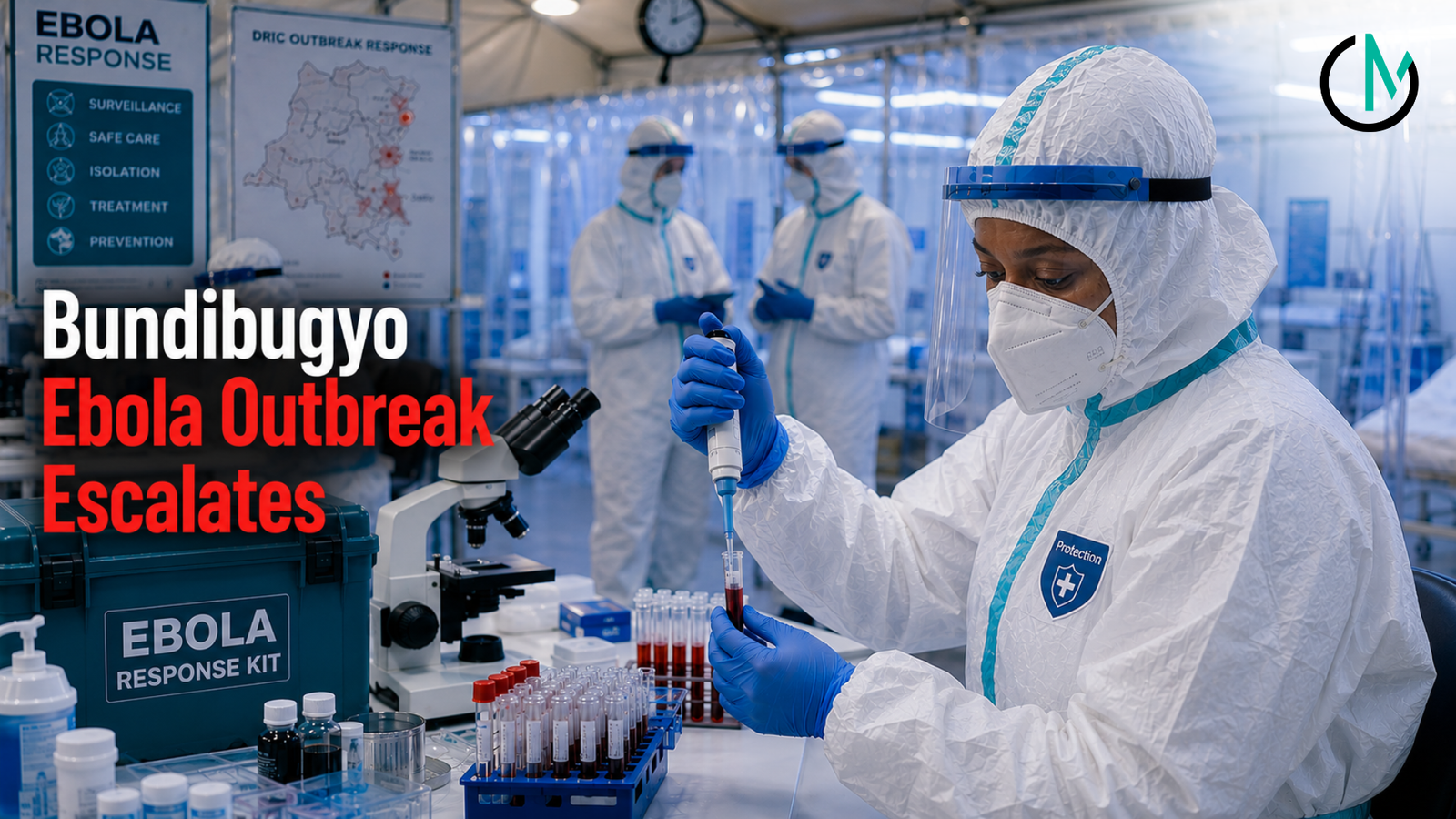
A fast-spreading outbreak of the rare Bundibugyo Ebola strain in the Democratic Republic of the Congo has killed 2,325 people and infected nearly 5,000 as of August 2026, making it the deadliest epidemic in the country's history.
Since the 2014–2016 West Africa epidemic killed more than 11,000 people, the world built an Ebola playbook. Rapid-response teams. Ring vaccination. A stockpiled vaccine, Ervebo, that works. Between 2018 and 2025, those protocols contained multiple outbreaks in the Democratic Republic of the Congo. However, the most recent one, in Kasai Province, was declared over in December 2025 after 45 deaths.
Then in May 2026, a cluster of severe illness surfaced in Ituri Province in the country's remote northeast. When the lab results came back, they named a virus almost nobody had planned for: Bundibugyo.
Three months later, the DRC's national public health institute reports 4,945 confirmed cases and 2,325 deaths, with 101 new infections logged in a single 24-hour period. It is now the deadliest Ebola outbreak in the country's history, having passed the 2,299 deaths of the 2018–2020 Kivu epidemic. The UN's humanitarian chief, Tom Fletcher, put it bluntly last week: "Ebola is winning in the Democratic Republic of the Congo."
The Deadly Strain is Outpacing Global Defense
"Ebola" is not one virus. It's a family. Four members of the Orthoebolavirus genus cause disease in humans, and the tools we have are strain-specific in a way that matters enormously right now.
As of now, there is only one available vaccine, Ervebo. This licensed vaccine has repeatedly turned DRC outbreaks that have been caused by the Zaire ebolavirus. So are the two approved monoclonal antibody treatments that have cut death rates in recent epidemics. Against Bundibugyo virus, there is no licensed vaccine and no approved targeted treatment. Not one. Bundibugyo isn't new. It was identified in Uganda in 2007 and had caused a couple of small, contained outbreaks before this year, with historical death rates in the 30–50% range. It was simply never a priority. It had never done anything like this.
The speed is the story
Case counts alone undersell what's unusual here. Consider the pace:
- The outbreak passed 1,000 confirmed cases within 40 days of the response activating. The 2018 Kivu outbreak took roughly 235 days to reach the same point.
- It is spreading faster than the 2014–2016 West Africa epidemic, the largest Ebola outbreak ever recorded.
- WHO declared it a Public Health Emergency of International Concern on 17 May, two days after the outbreak was announced. That is extraordinarily fast.
The rising case fatality ratio is particularly critical. The ratio, which denotes the share of confirmed patients who die, has climbed from around 20% in early June to 46% now. Nearly one in two.
That trajectory is backwards. Outbreak response is supposed to bend that curve downward as contact tracing improves, patients arrive earlier, and supportive care works better. MSF specialists deployed in the DRC have described the opposite pattern here, with cases still being found far too late, many only identified after the person has already died in their community. A rising fatality rate three months in is a signal that detection is losing ground, not gaining it.
Why containment is so hard

Geographic barriers and political instability significantly complicate response efforts. The epicentre sits in eastern DRC, spanning Ituri, Haut-Uele, North and South Kivu, and Tshopo. This is a region of thin health infrastructure, difficult terrain, and active armed conflict along the borders with South Sudan, Uganda, and Rwanda. One of the early confirmed cases travelled to Goma, a city under the control of the March 23 Movement. Contact tracing requires trust, access and time. Active conflict makes these measures extremely difficult to implement.
The virus has crossed borders. Uganda confirmed cases in Kampala, its capital, though as of mid-August its cases had been contained without community spread. In the United States, no locally acquired case has been reported; one American health worker infected while treating patients in the DRC was evacuated to Germany for care in May. CDC continues to assess the risk to the general public as low, because Ebola spreads only through direct contact with the bodily fluids of a symptomatic person or contaminated materials, not through the air.
It is important to distinguish Ebola transmission from airborne viruses. This is not COVID-19. WHO has said the outbreak does not meet the criteria of a pandemic emergency, and has advised against closing international borders. The catastrophe here is intense and local, and it is being borne overwhelmingly by Congolese families and Congolese health workers.
The scramble for tools
CDC continues to assess the risk to the general public as low, because Ebola spreads only through direct contact with the bodily fluids of a symptomatic person or contaminated materials, not through the air. WHO's R&D Blueprint had trial protocols drafted before this outbreak was declared, and it shows:
- PARTNERS, a treatment trial evaluating two antiviral therapies alone and in combination, began enrolling patients on 2 July at sites across Ituri.
- The world's first Bundibugyo-specific vaccine candidate entered human trials in the UK on 24 July, with ChAdOx1 BDBV being built on the Oxford viral-vector platform.
- Moderna's mRNA-1469 dosed its first participant in Canada on 3 August, in a CEPI-backed Phase 1 trial of about 80 healthy volunteers.
- A third candidate, from IAVI, is in development, though sufficient doses for a large efficacy trial are months away.
- On 31 July, a WHO technical advisory group voted near-unanimously to prioritise Ervebo for a Phase 3 trial against Bundibugyo, which is a calculated bet. Across animal studies, three of four vaccinated primates survived the Bundibugyo challenge, compared with one of four controls. Gavi has offered stockpile doses. As Tedros Adhanom Ghebreyesus has carefully said, nobody yet knows whether it protects humans against this strain.
A new 100-bed treatment centre has opened in Bunia, Ituri's capital. CEPI has triggered its highest level of emergency response and is appealing for funding.
The Determining Factors behind the rapid transmission
Three things will determine how this ends.
- Detection speed. The fatality ratio is a proxy for how late patients are arriving. If it starts falling, the response is catching up. If it holds near 46%, it isn't.
- The Ervebo trial. If a stockpiled vaccine already sitting in a warehouse offers even partial cross-protection, it changes the arithmetic immediately. Clinical trial data will determine its effectiveness.
- Geographic spread. The outbreak reached a sixth province in mid-August. Every new province means new supply lines, new trust-building, new burial teams.
The uncomfortable lesson is the one preparedness experts have been repeating for a decade: a vaccine against one member of a viral family is not a defence against the family. Sudan virus outbreaks kept arriving with no licensed vaccine. Bundibugyo was flagged as a gap. Vaccine development remained incomplete until this outbreak occurred. Medical tools are being developed concurrently with the active outbreak response, but production and deployment capacity remain critical bottlenecks.
Sources:
https://www.who.int/emergencies/situations/ebola-outbreak---drc-2026
