
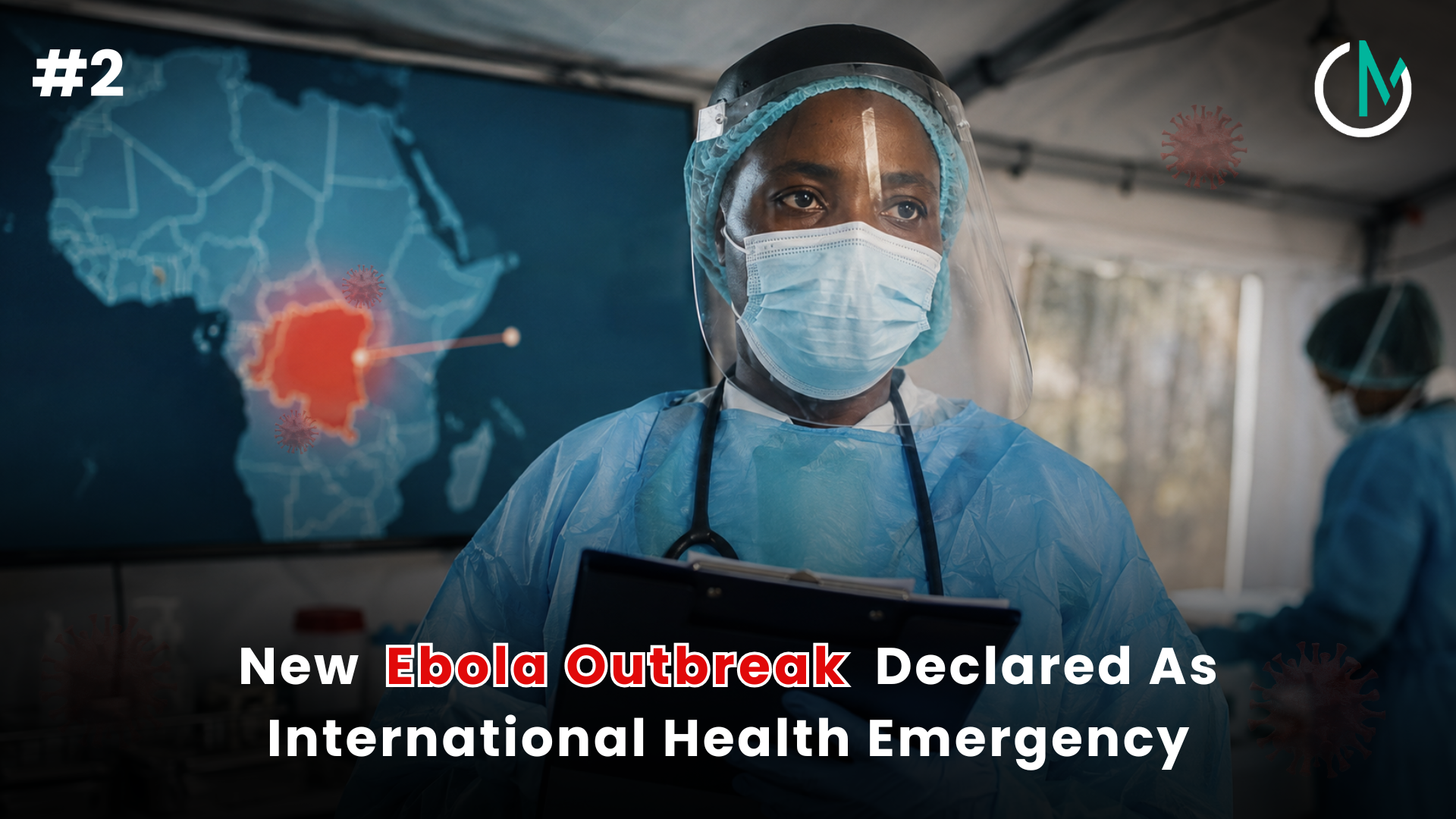
The World Health Organization has declared the Ebola outbreak in the Democratic Republic of the Congo and Uganda a Public Health Emergency of International Concern (PHEIC). At least 130 deaths have now been linked to the outbreak, alongside more than 500 suspected cases spread across several health zones in Ituri Province. Cases have since appeared in Kampala, Uganda, among patients who had recently travelled from the DRC, meaning this is no longer a story confined to a remote corner of one province.
How Ebola spreads and why it is difficult to contain
Ebola is a zoonotic disease, the medical term for an illness that lives in animals and occasionally jumps into people. It’s most likely natural reservoir is the fruit bat, which carries the virus without dying from it, and that is part of what makes bats such effective long-term hosts. The leap into humans usually happens through contact with the blood or bodily fluids of an infected animal, whether a bat, chimpanzee, gorilla, or forest antelope. For that reason, hunters and people who handle bushmeat are almost always at the highest risk of becoming the first human case in a new outbreak.
Once it is inside a person, the virus causes a severe viral haemorrhagic fever, attacking the vascular system that delivers oxygen to every organ. From there, it progresses through high fever and internal and external bleeding toward organ failure. Between people, it spreads through direct contact with infected blood or bodily fluids, which is why healthcare workers and family caregivers tend to be among the most exposed. There is no specific cure, so treatment stays supportive: clinicians manage fluids, stabilise blood pressure, and try to keep the patient alive long enough for their own immune system to fight back.
Ground zero: why Ituri was always at risk
The outbreak began in Ituri Province in eastern DRC, one of the most conflict-affected and under-resourced regions on the continent. The conditions there read like a textbook list of everything that helps a virus spread quickly and quietly, from ongoing insecurity and a years-long humanitarian crisis to high population movement, an urban setting at the centre of the hotspot, and a sprawling network of informal clinics operating outside the formal system. Those same conditions drove the 2018 to 2019 Ebola epidemic in this region, which is part of why public health officials are so uneasy now.
The deeper problem is detection. Weak health infrastructure, limited laboratory capacity, and deep community distrust of outside responders all mean that cases get spotted later than they should, and by the time a chain of transmission is identified, it has often already branched.
No vaccine. No treatment. No playbook.
This is the part that has WHO genuinely worried. The Ebola outbreak the world spent the last decade getting ready for is not this one. The vaccines and licensed therapies developed and stockpiled over recent years are specific to the Zaire strain, which has driven most major historical outbreaks, but this outbreak is caused by the Bundibugyo virus, for which there are currently no approved vaccines or treatments. The entire pharmaceutical toolkit built up over ten years simply does not apply here, which leaves clinicians with supportive care and little else.
The situation inside the facilities is harder still. At least four healthcare worker deaths have been reported in circumstances consistent with viral haemorrhagic fever, and that is not a small detail. When healthcare workers start dying, it usually signals that infection prevention is breaking down, and it raises the real risk that the places people go for help become places the virus spreads.
The community side of this has been just as difficult. On Thursday, protesters set fire to an Ebola treatment centre at Rwampara General Hospital, near Bunia in Ituri, after a dispute over a local footballer’s death from Ebola. Tensions erupted after his family attempted to take his body for burial. When health officials enforced strict Ebola burial protocols and refused to release the body, the crowd reacted by throwing projectiles. Two hospital tents burned down completely, and six patients had to be moved to the main hospital. The primary reason for this outrage is misinformation. In parts of Ituri, many people genuinely believe Ebola is a lie or a foreign invention, and that aid groups make it up for money. An outbreak is almost impossible to contain when the community being protected is the one fighting the response.
Why the world cannot look away this time
Under the International Health Regulations, Ebola has been declared a Public Health Emergency of International Concern. Since the outbreak poses a real risk of spreading across borders, it requires a coordinated global response. After assessing the situation, the WHO has concluded that it should be deemed a PHEIC.
The reasoning becomes clearer when the signals are laid out together. Initial samples came back with a high positivity rate, one of the clearest indications that the true case count is larger than what has been confirmed. Cases have already turned up in Kinshasa and Kampala, both major urban hubs with international airports, and there are signs the virus is reaching conflict zones, with a suspected case reported in M23-controlled South Kivu. On top of that, the WHO has flagged neighbouring countries that share land borders with the DRC as high risk, given the heavy cross-border movement and the uncertainty about how far the virus has already travelled.
One American has tested positive. Dr Peter Stafford, a missionary surgeon infected while working in the DRC, is now being treated in Germany. Six high-risk American contacts have been moved to Europe for monitoring. No cases have occurred on US soil, and the CDC says public risk remains low. For now, WHO assesses the wider global risk as low. That assessment, though, rests entirely on what is currently known. The next few weeks will decide whether this stays a regional emergency or becomes something the rest of us have to plan for.
What the outbreak means for practice owners
Every infectious disease outbreak plays out the same way in the billing department. New codes get added in the middle of the quarter. Insurers change their eligibility and prior-auth rules without much warning. And all of those changes go straight into the AI bots that insurers now use to reject claims automatically.
The practices that get through an outbreak in good financial shape are usually not the ones with the best appeal teams. They are the ones who fixed things at the front end. They check eligibility before the visit. They clean up documentation before charge entry. They send a clean claim that gets paid the first time.
That difference does not show up right away. It shows up later, in the A/R report, long after the outbreak is out of the news. And once a practice is stuck chasing appeals, a surge is very hard to survive.
This is where OneMed Billing comes in. We work the front end of your billing: verifying eligibility, reviewing documentation, and scrubbing every claim before it goes out. So when the next outbreak brings new codes and rule changes, your billing keeps moving instead of backing up. Hence, prepare your billing workflow before rule changes turn into denials.
Book an assessment call with OneMed Billing at (315)-366 8242 or send an email to partners@onemedbilling.com.
Source: World Health Organisation.
Figures reflect the most recent WHO reporting as of May 22, 2026.



Leave a Reply